Hadrian’s Wall was the north-west frontier of the Roman Empire for nearly 300 years….built by the Roman army on the orders of Emperor Hadrian after his visit to Britain in AD 122. At 73 miles (80 Roman miles and 118 kilometers) long, it crossed northern Britain from Wallsend on the River Tyne in the east to Bowness-on-Solway in the west, which was made a World Heritage Site in 1987.
The wall comprised a massive stone and turf rampart, a deep V-shaped northern ditch, 80 milecastles, and 158 watch turrets. However, the wall was far more than a simple military line. It was a sophisticated frontier control system designed to regulate trade, monitor immigration, and project Rome’s unyielding imperial might across the northern edge of Britannia.
The logistics required to maintain the wall were staggering, as forts like Housesteads and Birdoswald functioned as bustling frontier towns. They housed hundreds of auxiliary troops, their families, local merchants, and camp followers during the conflict, protecting Roman land from attacks by fierce tribes in the north (the area now known as Scotland). These garrisons formed a complex cultural melting pot where Mediterranean civilization clashed and mingled with native Brittonic traditions. The wall also institutionalized division, marking a stark boundary between the “civilized” provinces of the south and the untamed tribes of the north.
After Hadrian’s death in AD 138, a new emperor came to power, Antoninus Pius, who abandoned Hadrian’s Wall and moved the frontier up to the Forth–Clyde isthmus. There he built a new wall, the Antonine Wall. But not every frontier made it to the finish line, and this one lasted only about 20 years before being abandoned in favour of a return to Hadrian’s Wall.
Long after the departure of the Roman legions in the 5th century, the wall had been slighted when abandoned, and the milecastle gates removed and crossings thrown across the Vallum ditch. It looks like Hadrian’s Wall remained in this state until the late 2nd century, when a major war began after tribes crossed the Wall, dividing them from the Roman forts and killing a general and the troops he had with him. The story and some sources hint that it probably caused some changes to the Wall, including the abandonment of many of the turrets in the crags sector and a redeployment of the army.
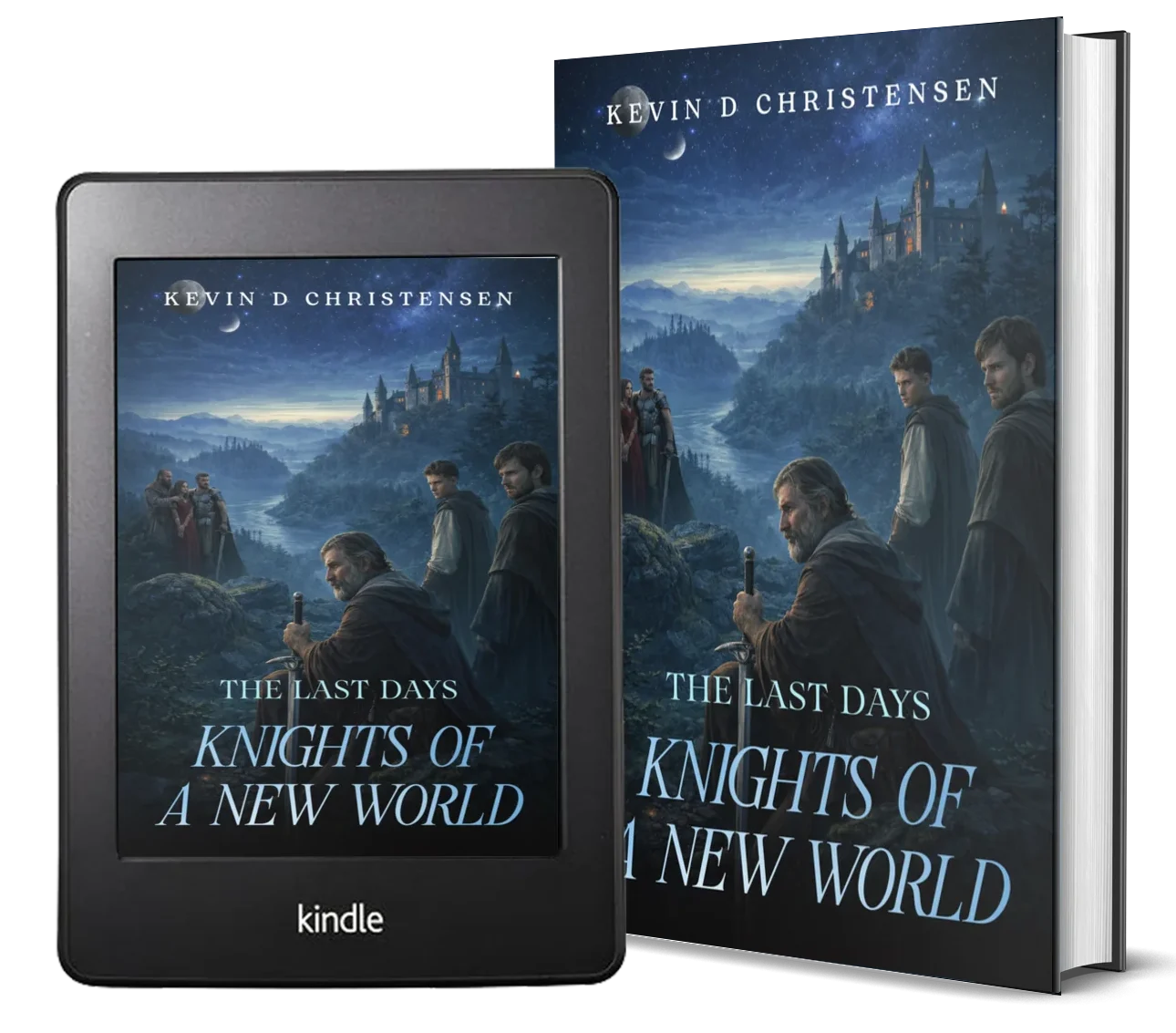
This historic collision zone between empire, borderlands, and ancient power serves as the atmospheric bedrock for Kevin Christensen’s Knights of A New World. In the novel, the rugged geography surrounding Hadrian’s Wall transforms into a high-stakes arena where covert operatives, local villagers, and advanced off-world factions collide, transforming this monument and heritage of Britain into a futuristic arena of power and combat, where every page offers a new twist and turn.
Set against the atmospheric, mud-and-blood landscape of a fractured, sub-Roman Britain, the story initially feels like classic Arthurian lore. Tribal kings rule by the edge of iron swords, and native populations navigate a small, superstitious world near Hadrian’s Wall.
But then, the sky opens up, and Atlantis appears as a hyper-advanced, industrialized, spacefaring superpower. When these “Off-Landers” descend upon Britain, they bring atmospheric aircraft, data files, and corporate banking clans demanding resource rights. What follows is an incredible clash of civilizations where ancient prophecies are weaponized as political propaganda. Blending the sweeping tension of a space opera with the gritty reality of ancient warfare and modern political issues, Knights of A New World is an absolute must-read that redefines speculative fiction and will provide you with a great time.
Visit the author’s website, https://authorkevinchristensen.com/, to learn more.